Know your light.
Know your plant.

Most plant apps guess. Leafed works out the light your plants actually get — using the geometry of your flat, the sun's real position, and today's sky.

iOS 17+ · Launching soon
Leafed's Today screen — the day's light, and the plants that need watering, one card at a time
Features

Built on real science, not rules of thumb.

Every feature in Leafed is built on a measurement — not a generalisation. Here's how each one actually works.

Light mapping

The only app that does the maths.

Every plant care guide says "bright indirect light." That phrase means something different in a south-facing flat in Chennai versus a north-facing apartment in Delhi. Leafed replaces the label with a number — the Daily Light Integral your plant actually receives at that window, that month.

1
Window geometry, not just a compass direction
You describe your window's bearing, width, height and floor. Combined with your city's coordinates, Leafed works out the sun's exact angle and altitude at every hour of the day — and how much of that light actually reaches your window.
2
Sky conditions factored in
A clear January day and an overcast one deliver very different light through the same window. Leafed pulls today's sky data and adjusts the calculation accordingly, rather than assuming clear skies every day.
3
Matched to your plant's real needs
Every plant has a validated light range — the minimum it needs to survive, the maximum before stress. Leafed matches your window's monthly curve to that range and tells you whether the spot works, and for which plants.
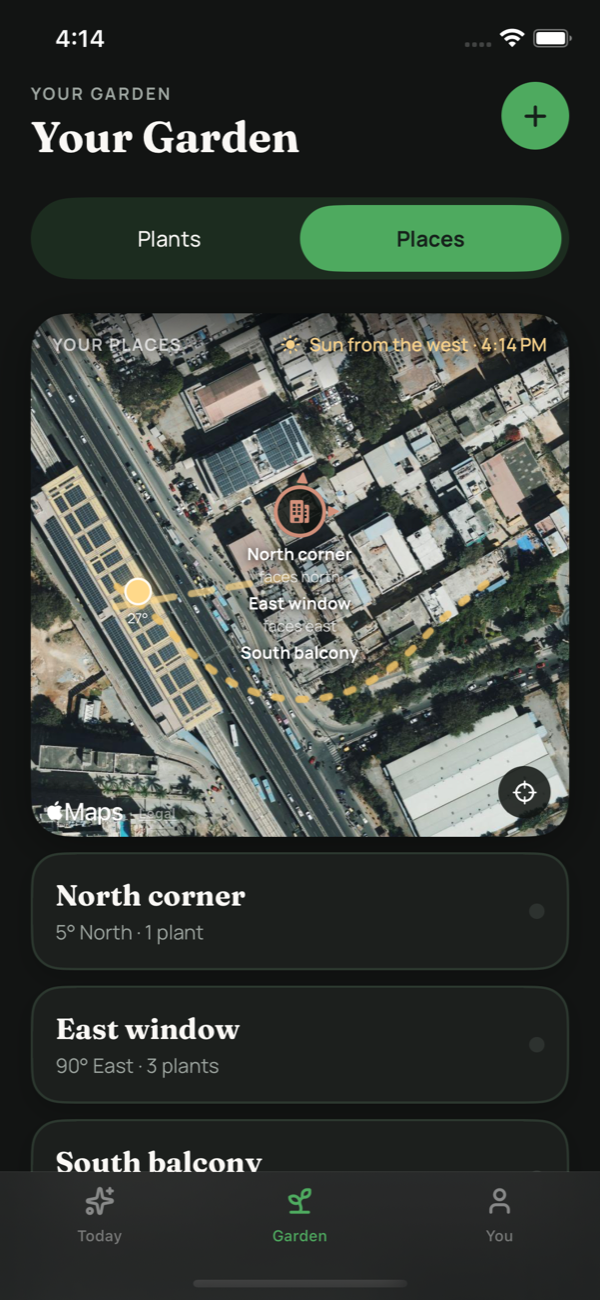
Your places on a map of where they actually are, each showing which way it faces, with today's sun path drawn over them
Sunlight through a sheer curtain
Light meter

Check the maths against the light in the room.

The calculation is only as good as what you told it. So while you hold the phone level at the window, the front camera reads how bright it actually is — and sets the measurement beside what the model predicted for that minute. No photograph is taken or kept, only the brightness.

1
A reading at four o'clock, read as a whole day
A measurement taken late in the afternoon is a correct measurement of late afternoon, and on its own it makes a bright place look dim. Leafed scales it by the model's own shape for that place — the ratio between four o'clock and noon is geometry — so the number you see is what the place gets at its brightest.
2
It keeps the readings that disagree
A reading that contradicts the model is the most useful thing the app can collect: it usually means the place was described wrongly — a balcony recorded as a window into a room, say. Leafed keeps it, says what a large disagreement normally means, and lets you correct the survey rather than quietly discarding the evidence.
3
Several readings, not one
A phone camera without a diffuser is worth about thirty percent either way — fine as an anchor, useless as a single verdict. Take a few at different times of day and the errors average out, and the place can correct the model's guesses about glazing, netting and bounce with a single figure.
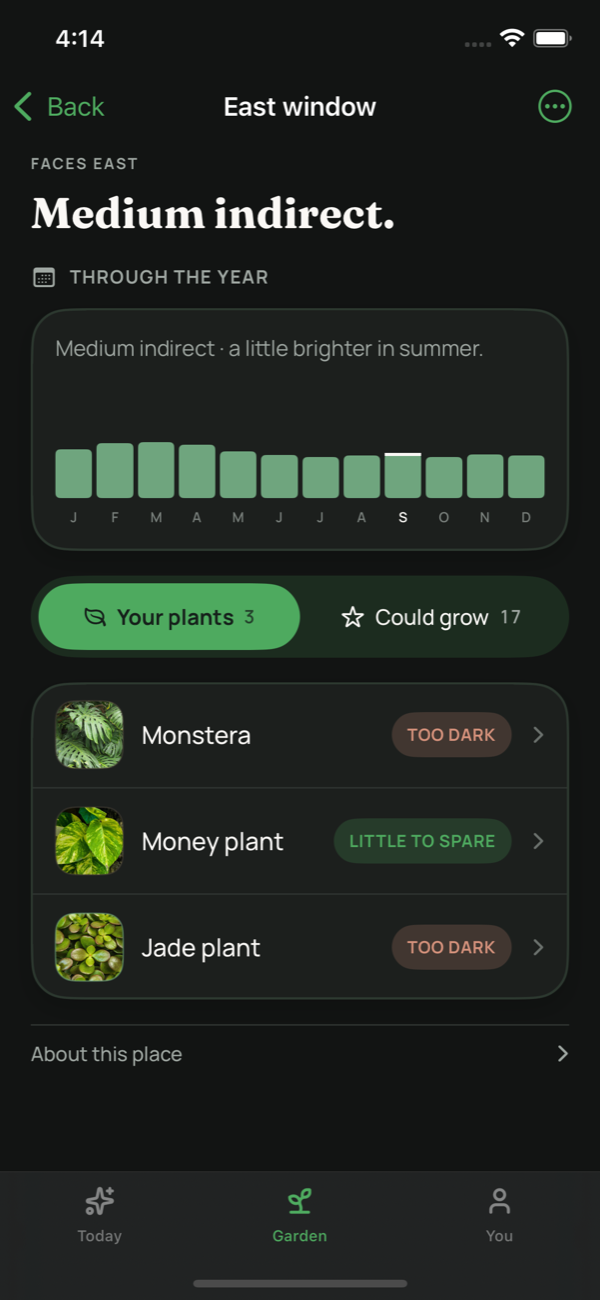
A place in Leafed, with the light it gets through the year and what its own measured readings say about that
A phone held up towards plants by a window
Diagnosis

One sentence. One cause. One fix.

Yellow leaves could be overwatering, underwatering, low light, or a dozen other things. Most apps hand you all twelve. Leafed cross-references your photo with your plant's actual light history and watering record — and gives you one plain-language answer.

1
Photo plus description
Take a photo of the problem and describe what you're seeing — yellowing lower leaves, brown tips, wilting, spots. The more specific you are, the more accurate the diagnosis.
2
Cross-referenced with your plant's history
Leafed doesn't diagnose in isolation. It checks your plant's DLI over recent weeks, when it was last watered, and whether conditions have changed — then weighs the most likely cause.
3
One plain answer
You get one diagnosis and one thing to do — not a list of possibilities and not a disclaimer. If the data points clearly to overwatering, Leafed says so, and tells you exactly what to change.
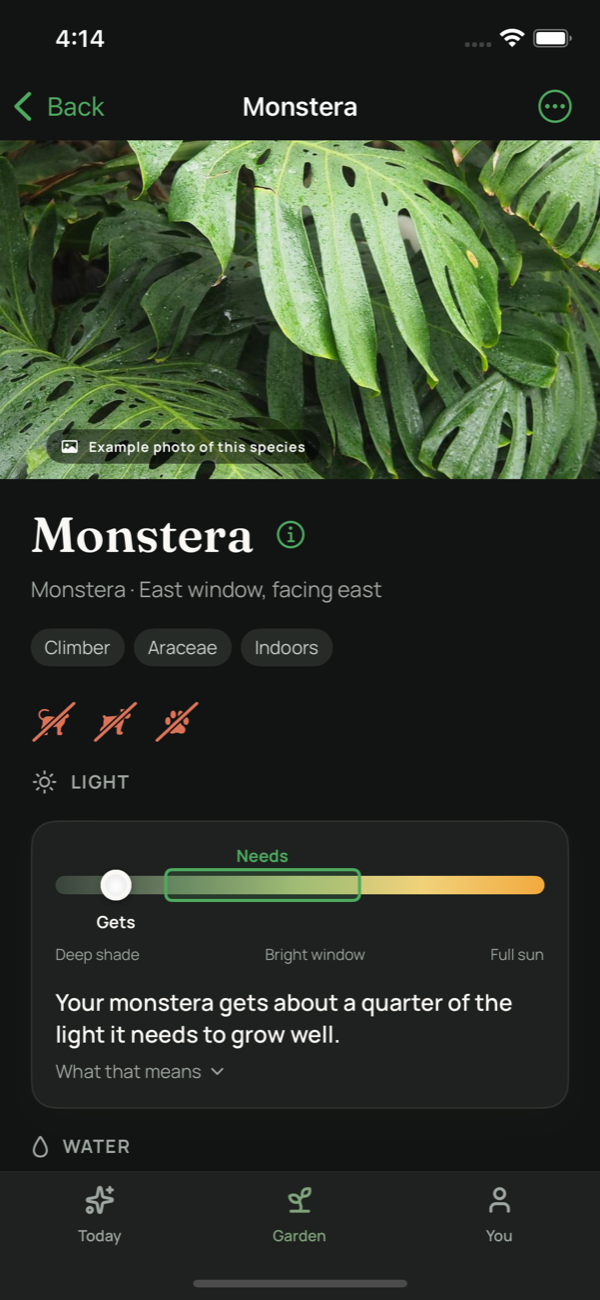
A plant's page in Leafed: the light it gets against the light it wants, what would fix it, and whether it is safe around cats and dogs
Close-up detail of a leaf
Smart watering

Watering that actually thinks.

A fixed schedule — water every seven days — ignores everything happening outside your window. Leafed connects to your city's live forecast and adjusts automatically. Rain coming? Hold off. Heat and dry? Water before it's asked for.

1
Live forecast, not a calendar
Leafed pulls real-time weather for where you are — sunlight, temperature, humidity, wind, UV, and how hard the air is pulling water out of a pot. Every reminder is built from today's conditions, not a schedule set three weeks ago.
2
Counts the rain that already fell
Not just the forecast. Leafed checks what actually came down over the last few days and works out how much of it reached each pot — a plant on a railing catches a shower the one against the back wall never feels, and nothing indoors gets any of it. Your watering moves on its own.
3
Tells you why, not just when
Every reminder includes a reason, in plain language, so you understand the logic and can override it when you know something the app doesn't.
4
Adjusts per plant, per spot
A plant on a south-facing balcony in summer dries out faster than one on an east-facing windowsill. Leafed tracks each one separately and reminds you accordingly.
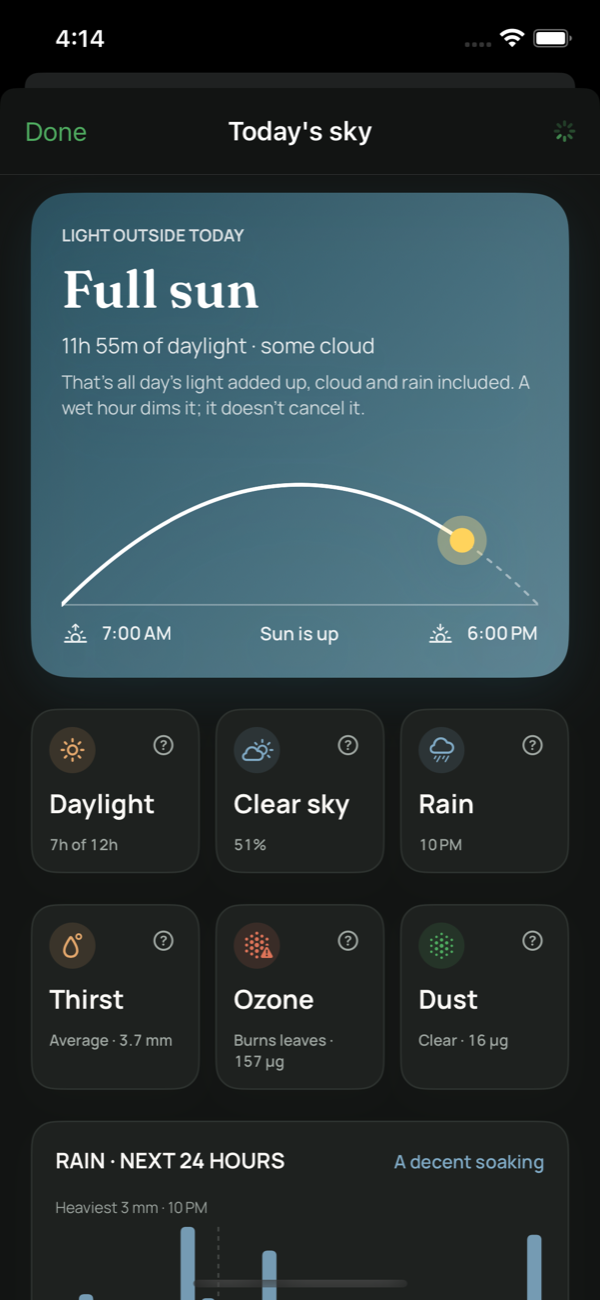
Today's sky in Leafed: daylight, clear sky, rain, the air's thirst, ozone and dust — each with what it means for a plant
A watered leaf
Setting up a place

Three questions, then every plant there is worked out.

You do this once per window or balcony. Everything the app says afterwards — the light each plant gets, when it needs water, whether it will still work in October — comes out of these answers, so they are the only part that asks anything of you.

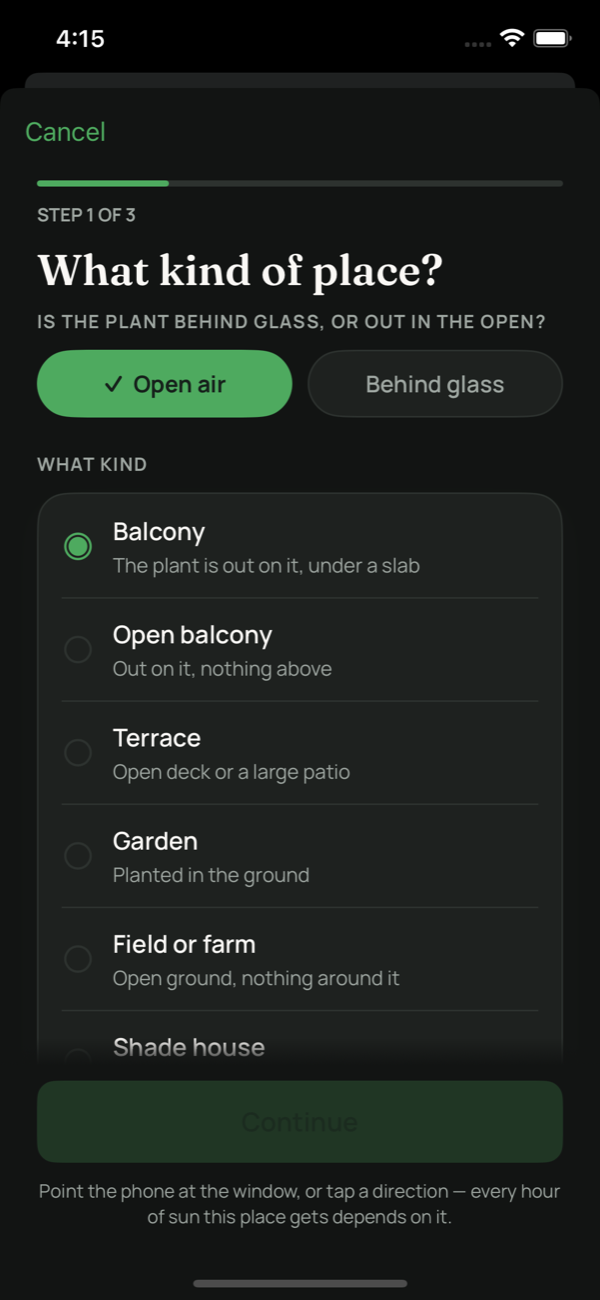
The first survey step in Leafed: is the plant behind glass or out in the open, and what kind of place is it
1

What kind of place

Behind glass or out in the open, and which — a balcony under a slab lets in a different sky from an open terrace or a grilled window. Point the phone at the window and the compass takes the bearing itself. While you hold it there, the front camera reads how bright it actually is.

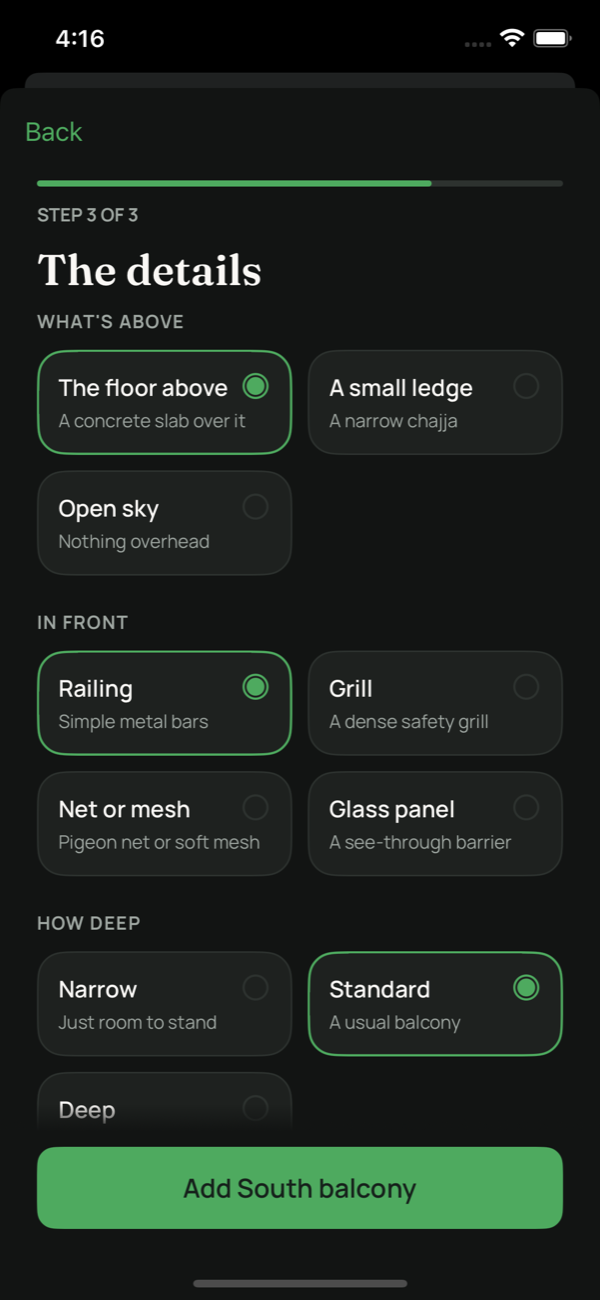
The second survey step: the floor you are on, and what stands opposite the window
2

Where exactly

Which floor, and what stands opposite — a building, a wall, open sky. A third-floor window facing a taller block gets a fraction of what the same window gets on the eleventh. This is the part every other app assumes away.

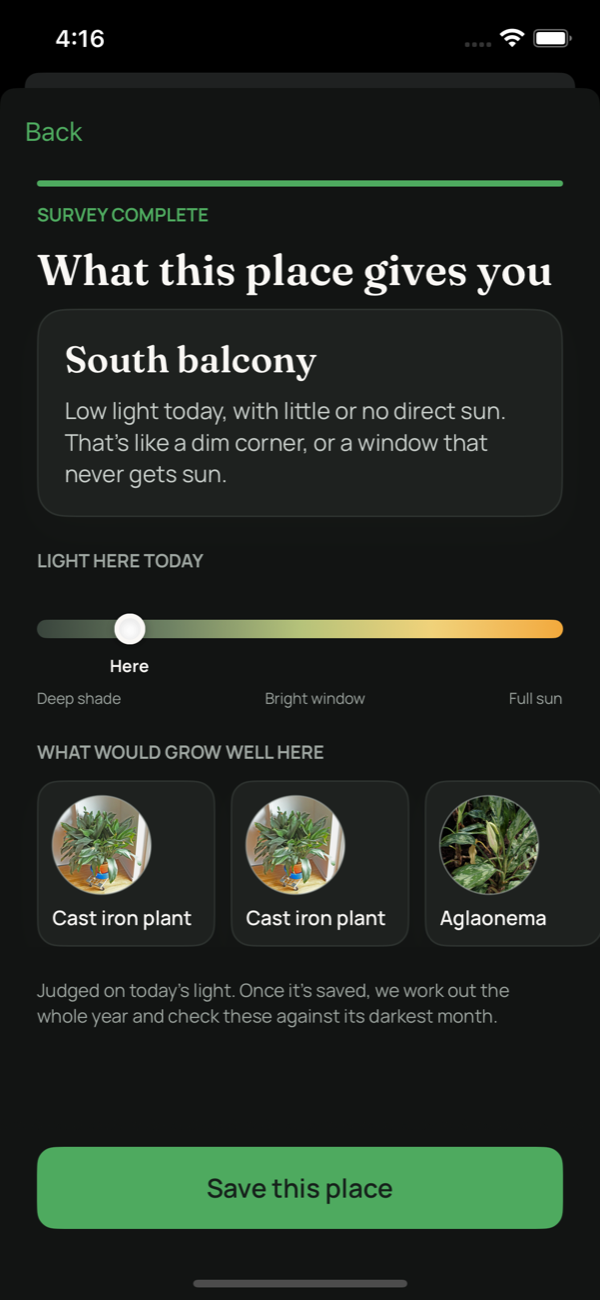
The result of a survey in Leafed: the light that place gets, month by month through the year
3

What that place gets

The light it receives month by month, in mol/m²/day, against what plants can actually live on. Every plant you put there inherits it — and a plant 30 cm from the glass and one 3 m back get different answers, because they get different light.

Why Leafed

Replace guesswork with data.

The houseplant industry runs on vague advice. Labels say "medium light" and "water when dry" — which means something different in every home, every season, every city. Most people who lose plants aren't neglecting them; the information they're working from is too imprecise to act on.

Leafed is built on a different premise: your phone already has everything needed to give accurate, specific plant care — a GPS for solar position, a camera to look at a struggling leaf, and a connection to your city's live weather. We built it in India, for Indian homes — the plants at Indian nurseries, the light conditions in Indian cities, the monsoon and the summer heat, all baked into how it works.

Honest about what we know

We don't show a confidence score we haven't earned. If a reading is uncertain, or a recommendation depends on data we don't have yet, we say so.

Specific over general

Generic advice is everywhere. We only show you something if it's specific to your window, your plant, your city, your season.

Built for people who care

Leafed is for people who genuinely want their plants to thrive and are frustrated that the tools available don't match that ambition.

Small team. Built in India.

We're building Leafed the way we wished a plant app worked for us first — measuring what a home actually gets, rather than telling people to guess better.

Download

Leafed for iPhone.

No account required to start. Coming to the App Store shortly.

What's included

Everything included.

Sunlight mapped for every window

Real Daily Light Integral for each spot in your home — from its geometry, your city's coordinates, and today's sky.

Forecast-adjusted watering

Reminders built from your city's live forecast, not a fixed calendar — with the reason, every time.

Plant suggestions for every spot

Each window gets a list of plants that would thrive there, judged on its darkest month so they last the whole year.

A light meter in the camera

Hold the phone level at the window and the front camera reads how bright it really is, then checks it against what the calculation expected. No photo is taken or kept.

Photo diagnosis

Photo plus description, cross-referenced with your plant's light and watering history. One plain answer.

570 species, and growing

Light and care profiles for the plants Indian nurseries sell — each one sourced and honestly labelled, with more added all the time.

Requirements

RequirementDetails
PlatformiPhone only (iOS 17 or later)
InternetRequired for weather data
PermissionsLocation (for solar position and to pin your places on the map), Camera (for leaf diagnosis, and to read the light at a place — no photo is kept for that), Notifications (for reminders)
PriceFree for 28 days, on one plant and two places. After that, plans from ₹49 a month — sized by how many plants you keep. Shown in your own currency in the App Store.
AccountNot required

Get in touch.

Reach out to us

We'll reach out to you